
Breaking down Digital Transformation
4 thoughts to help separate the value in digital transformation from the empty buzzword.

Welcome to A Bicycle for Design, a newsletter that explores how architectural and engineering design is being transformed by software and computers!
Today I would like to share 4 thoughts on the mythical concept of "Digital Transformation".
It's just another step in the process
A colleague once asked me, frustrated by someone's enthusiasm for Yet Another Change, "Haven't we already digitally transformed? We have all been using computers for years now!" It's true! As designers working on varied projects for varied clients, our work is always changing, and we have always adopted new tools and processes that help us do better work more quickly.
Change is a constant, and 'digital transformation' is a step-by-step process, not a one-time event.
There's something bigger going on
Despite the constancy of change, 'digital transformation' gets a lot of attention because it has the potential to change the structure of our industry and the nature of designers work and identity.
If you are interested in the underlying themes that make this transformation so intense, I highly recommend the book Capitalism Without Capital. The high-level takeaway is this: software has high-capital costs and minuscule marginal costs - this affects the input costs to the work of design and will enable (or impose!) entirely new business models for designers.
Keep it simple
A digital transformation scheme has a lot of moving parts: new tools, new skills, new attitudes. If you want to know where your team stands on the journey, you can compare yourself to a detailed map of the journey. This is the approach taken by Arup's BIM Maturity Measure. These approaches provide detailed guidance on next steps along a journey, but can also overwhelm us and generate significant debate about the details of the assessment.
In contrast, I was surprised by the simple and pragmatic definition given by Nancy McKinstry, CEO of the Dutch publishing house Wolters Kluwen in an interview with the Harvard Business Review: the percentage of the firm's revenue that comes from non-print products is how digitally transformed the firm is. This definition is perfectly clear and unambiguous. Instead of mapping out the entire process of training and tools and capabilities, it puts a sharp focus on the tipping point of a digital transformation: are we doing 'digital' work or simply doing our same old work in a 'digital way'?
For architects and engineers, I suggest a slight modification of the definition "What % of your revenue comes from deliverables that cannot be printed?" While many of us are now delivering PDFs instead of paper, they are fundamentally the same thing. The litmus test is delivering 3D models instead of flat drawings and live dashboards instead of static reports.
The bulk of the change won't get special attention
Truly transformative technologies create durable and lasting change - which means they become the boring status quo, and we stop talking about them as special things.
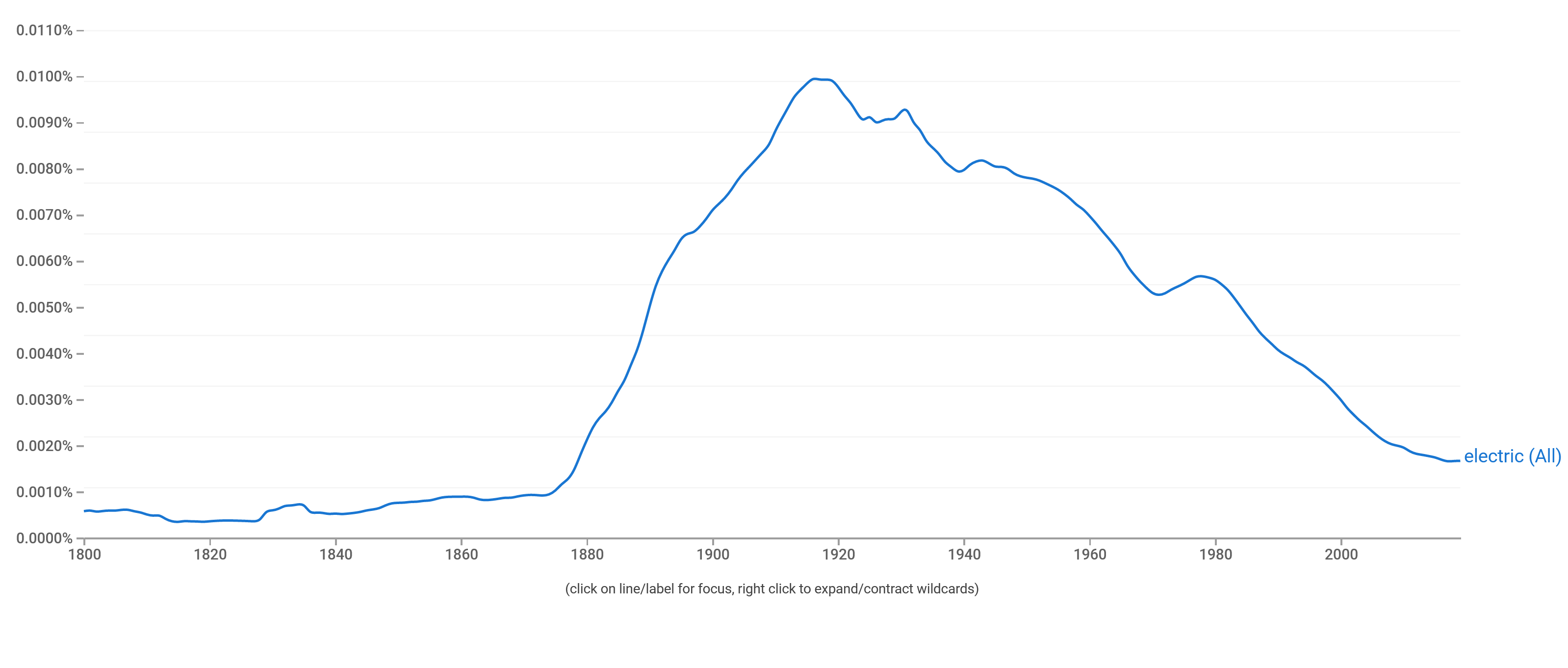
Take the word 'electric': according to Google n-grams, the use of the word electric (in the English language) peaked in 1916, despite the majority of North America not being electrified until the 1950's.
Adding in the word 'digital' suggests that we are still in the early stages of the change that software and computers will bring.
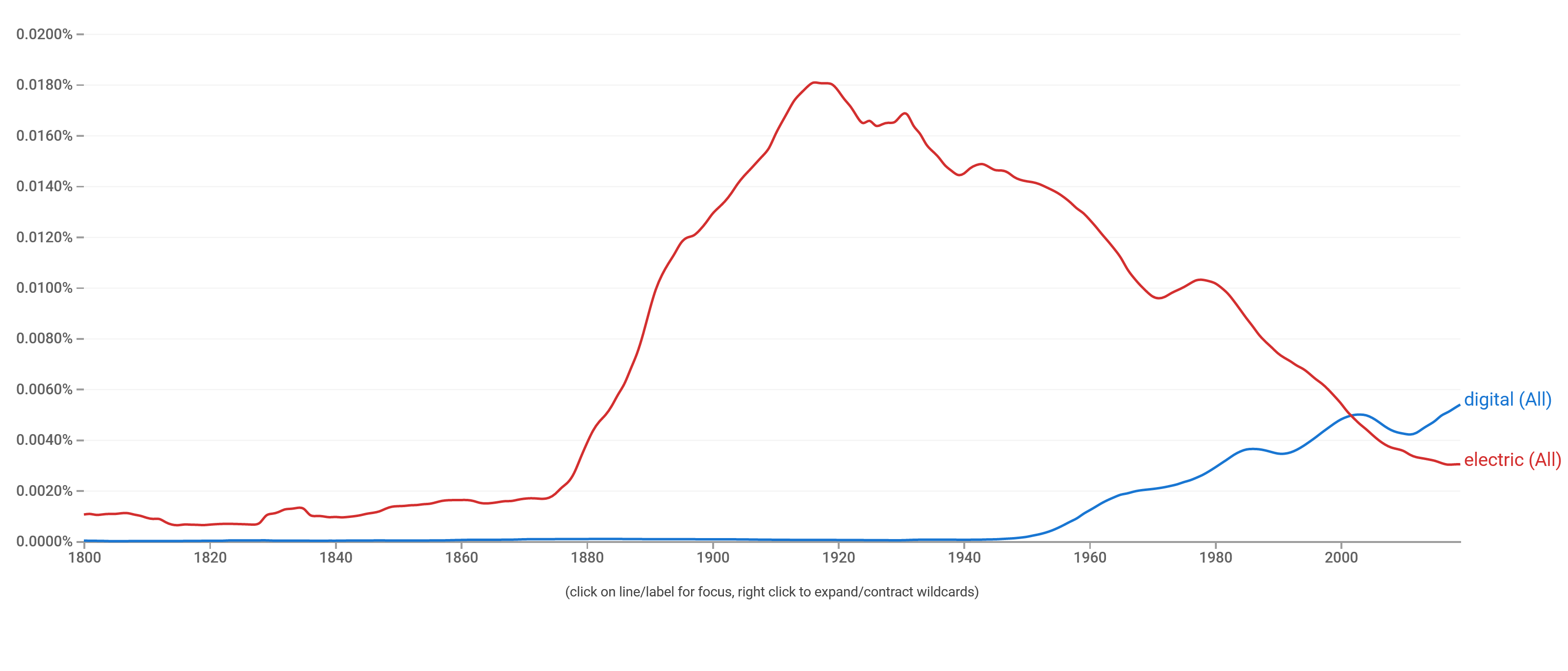
Though the future is here, it certainly isn't evenly distributed! As software continues to eat the world, we’ll stop talking about digital - it will just be the regular, boring way of doing things.